


ONS 2026 in Stavanger. The theme on the screen: Courage. Photo: Krafftwork.
This year I was at ONS in Stavanger, one of the largest gatherings of the energy industry. I was invited to discuss which future technologies could scale and carry the energy transition. The theme on every screen: Courage.
What struck me happened off stage. Over coffee and dinner, people spoke about green hydrogen in the past tense. Everyone seemed to have given up.
That stung. With my background in cars and transport, I had always hoped hydrogen would be one of the levers to accelerate the energy transition. So I wondered: Is all hope lost? Or is there still a path on which green hydrogen can keep its promise?
Has the industry given up too early? (The signal)
For decades hydrogen was hailed as the fuel for everything electricity cannot reach: fertiliser, steel, ships and planes. Today the mood has flipped.
The pipeline of projects announced for 2030 has shrunk two years running, to 27 million tonnes a year (IEA). New supply contracts fell in 2024 and stayed flat in 2025, at about 1.7 million tonnes a year (IEA). Equinor shelved its plan to pipe hydrogen from Norway to Germany, citing a lack of demand (Offshore Technology).
Yet more than 200 projects have reached a final investment decision since 2020 (IEA). Europe’s latest hydrogen auction drew six times more bids than its budget (HydroNews). The money to build capacity is there. The hydrogen buyers are not.
To judge whether a technology will make it, I use three gates.
Can it scale? Yes. The largest electrolyser plant grew from 30 megawatts in 2021 to 500 megawatts in China in 2025 (IEA). Gate passed.
Is it industrialised? Half-way. China makes about 60% of the world’s electrolysers, and the stack is becoming a product. But the stack is only 15 to 20% of a plant’s cost (IEA). The rest is still stuck in project economics, where delays and budget overruns are still common.
Is there a market? Not yet. Firm contracts cover about 5% of the supply announced for 2030 (IEA), and many buyers expect that they cannot pass on the green premium.
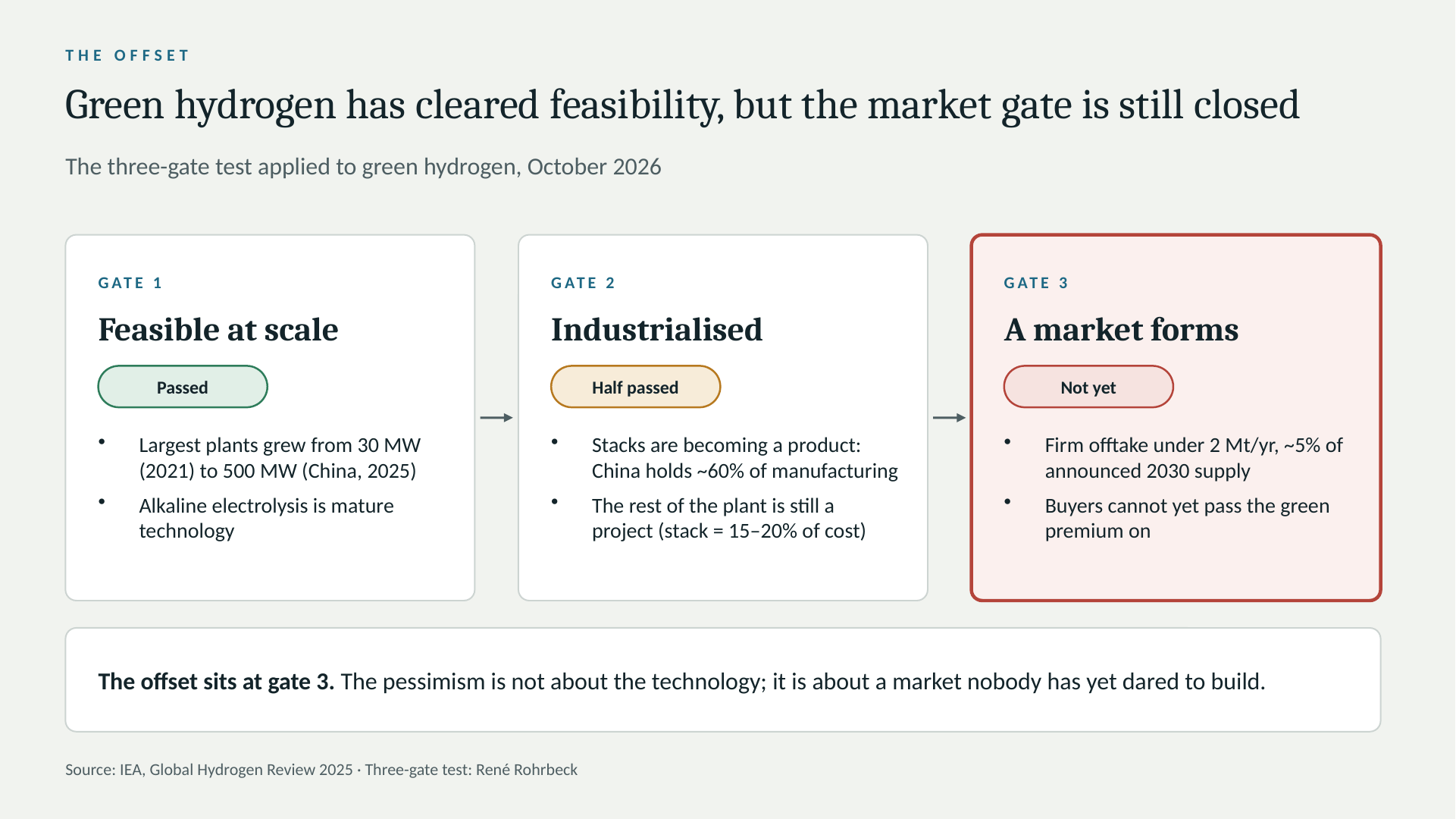
Exhibit 1. Green hydrogen has cleared feasibility, but the market gate is still closed.
A procurement department would stop here. As a foresighter I am keen to look ahead and work backwards. I wonder, what would it take to pass all three gates?
Scale first, then fertiliser (The offset)
The answer starts with cost. Today, a European electrolyser costs about $2,300 per kilowatt. A Chinese one costs $500 to $1,100 (IEA). To make fertiliser switch, it needs to fall to about $400, which gives hydrogen at roughly $2.20 a kilo.
Costs fall as volume grows. A common assumption is 18% cheaper with every doubling of output (IRENA). Before going on stage, I ran the numbers.
So far the world has installed only about 4 GW of electrolysers (IEA). Europe’s 40 GW target alone is ten times that, but only a little over three doublings away. That brings the cost to about $1,200, still above China’s most expensive systems today.
At 250 GW it falls to about $700. Matching China’s cheapest takes around 800 GW. Reaching $400 takes roughly 1,800 GW.
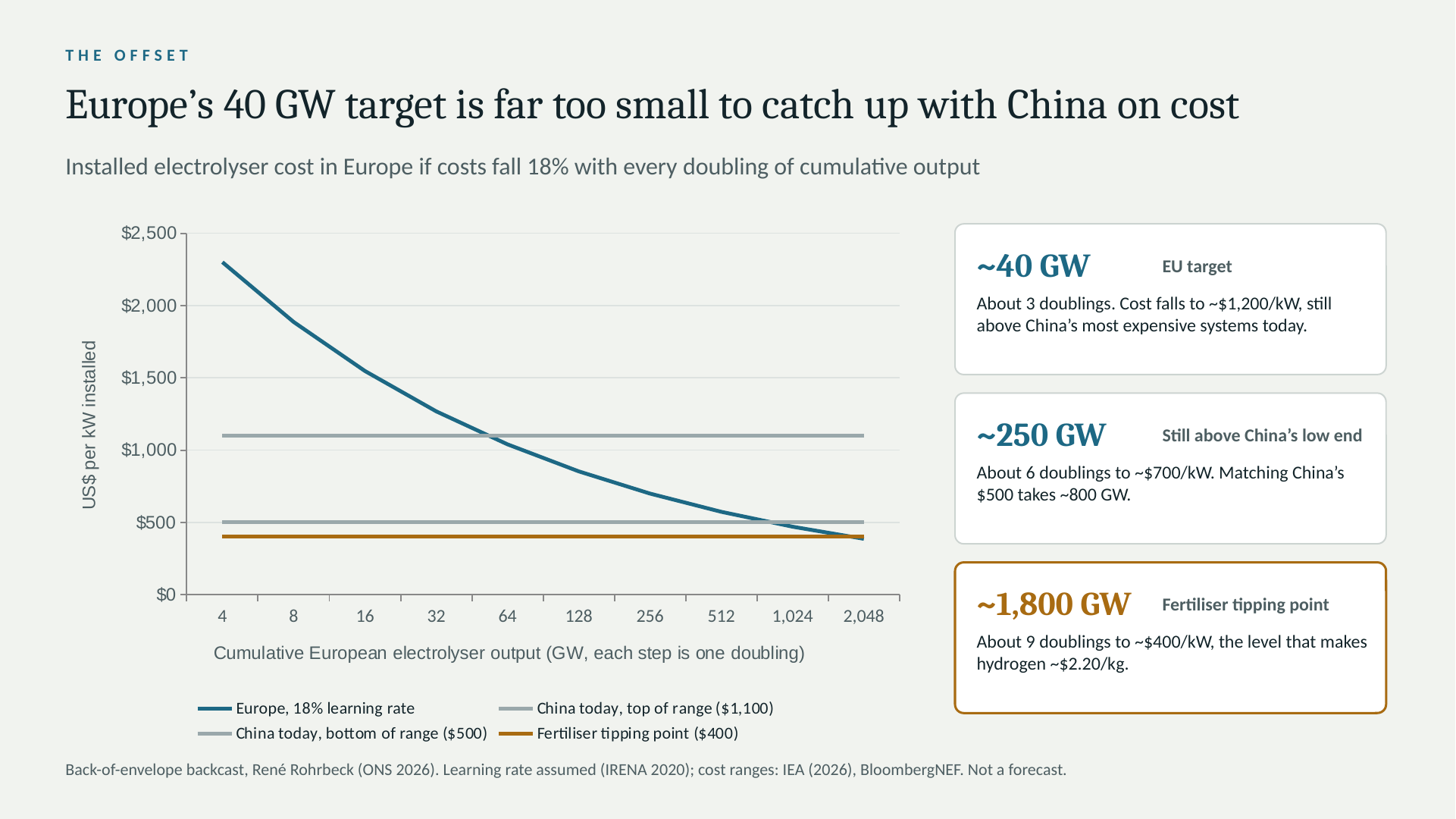
Exhibit 2. Europe’s 40 GW target is far too small to catch up with China on cost. A back-of-the-envelope backcast, not a forecast.
So hydrogen’s cost problem is not about technology. It is about scale. And scale needs buyers.
The good news: the factories already exist. The world can make about 58 GW of electrolysers a year, around 60% of it in China. In 2025 the world made fewer than 5 GW, so roughly nine in ten production lines stood idle (IEA, via Argus). To scale up we need confidence that buyers will be there. So an interesting question is: Which buyers can go first?
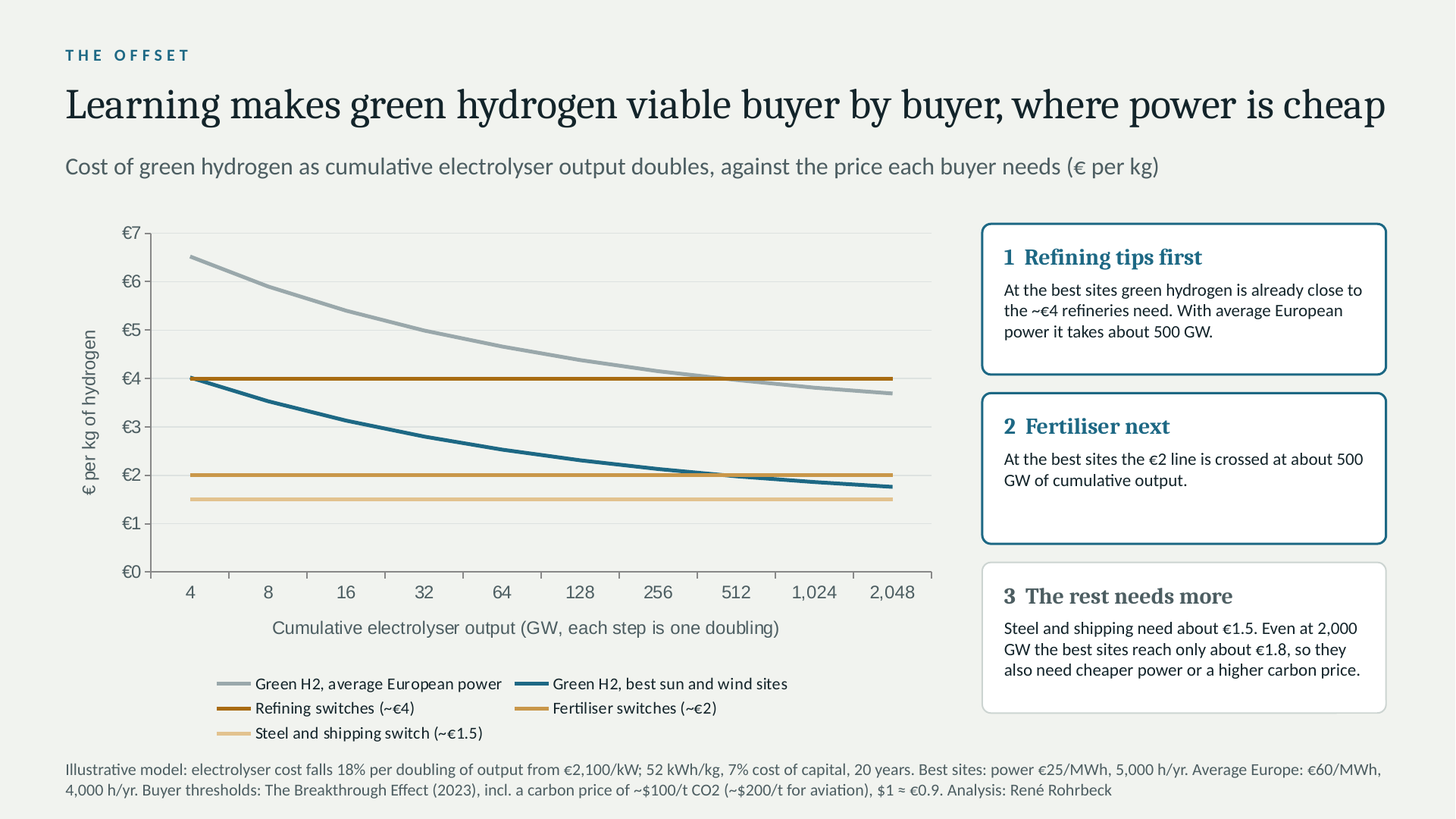
Exhibit 3. Learning makes green hydrogen viable buyer by buyer, where power is cheap. An illustrative model, not a forecast.
Today, green hydrogen costs about €6.70 a kilo in Europe, and as little as €4 at the best wind and solar sites. Hydrogen made from natural gas costs about €3.30 (European Hydrogen Observatory). Every doubling of electrolyser output pulls the cost of green hydrogen down, as electrolysers get 18% cheaper with each doubling. At the best sites it reaches about €2.10 a kilo at 250 GW of cumulative installed capacity. At 500 GW it drops below the €2 that fertiliser production needs to reach cost parity. With average European power prices, it never gets below about €3.70, because the electricity alone costs about €3 a kilo. So there is potential if we can reach and motivate the first customer industries to become anchor buyers that help to drive the cost down.
Refining and fertiliser, first. Both already use hydrogen made from gas, so green hydrogen adoption is only about replacing the feedstock; no change in the production facilities would be needed. Refineries could switch at about €4 a kilo, when factoring in the price for CO2 emission permits. In addition regulation can help. Already today, Europe’s carbon border tax makes imported grey ammonia 10 to 20% more expensive, and about 50% more expensive by 2030, according to Rabobank.
Aviation fuel, with a compulsory blend. Today, synthetic jet fuel costs about ten times as much as fossil kerosene (EASA, via SAF Investor). Yet from 2030 EU airlines must blend a small share, which will rise in steps to 35% by 2050. Spread over millions of tickets, the first step adds about €15 to a long-haul flight (T&E). Airlines are lobbying to delay it, but for now the demand is written into law (FuelCellsWorks) and could make aviation the next buyer to scale the green hydrogen market.
Steel and shipping still have a long way to go. For cost parity steel and shipping need green hydrogen at €1 to €2 a kilo or customers willing to pay a green premium. While green steel for construction may carry a price premium of 50%, this adds at most about 1% to the cost of a building (Sustainability by Numbers). Property developers and cities that impose low lifetime carbon emission standards could even make this market tip.
Between the buyer groups the cascading effect also helps. Each new buyer group builds the volume the next one needs for reaching the parity price. To start the cascade, the University of Exeter and Systemiq estimate that if governments required a quarter of fertiliser production to use green ammonia, meeting the demand would require almost 100 GW of electrolyser capacity. That would be enough to cut electrolyser costs by about 70% (The Breakthrough Effect).
Everyone is waiting for someone else (The backset)
If the technology works and a path exists, why the gloom?
Because everyone waits.
Electrolyser makers wait for orders.
Producers wait for buyers.
Buyers wait for lower prices.
Each wait is rational. Together, they make a standstill. What is missing is not technology. It is courage, the very theme ONS chose so wisely.
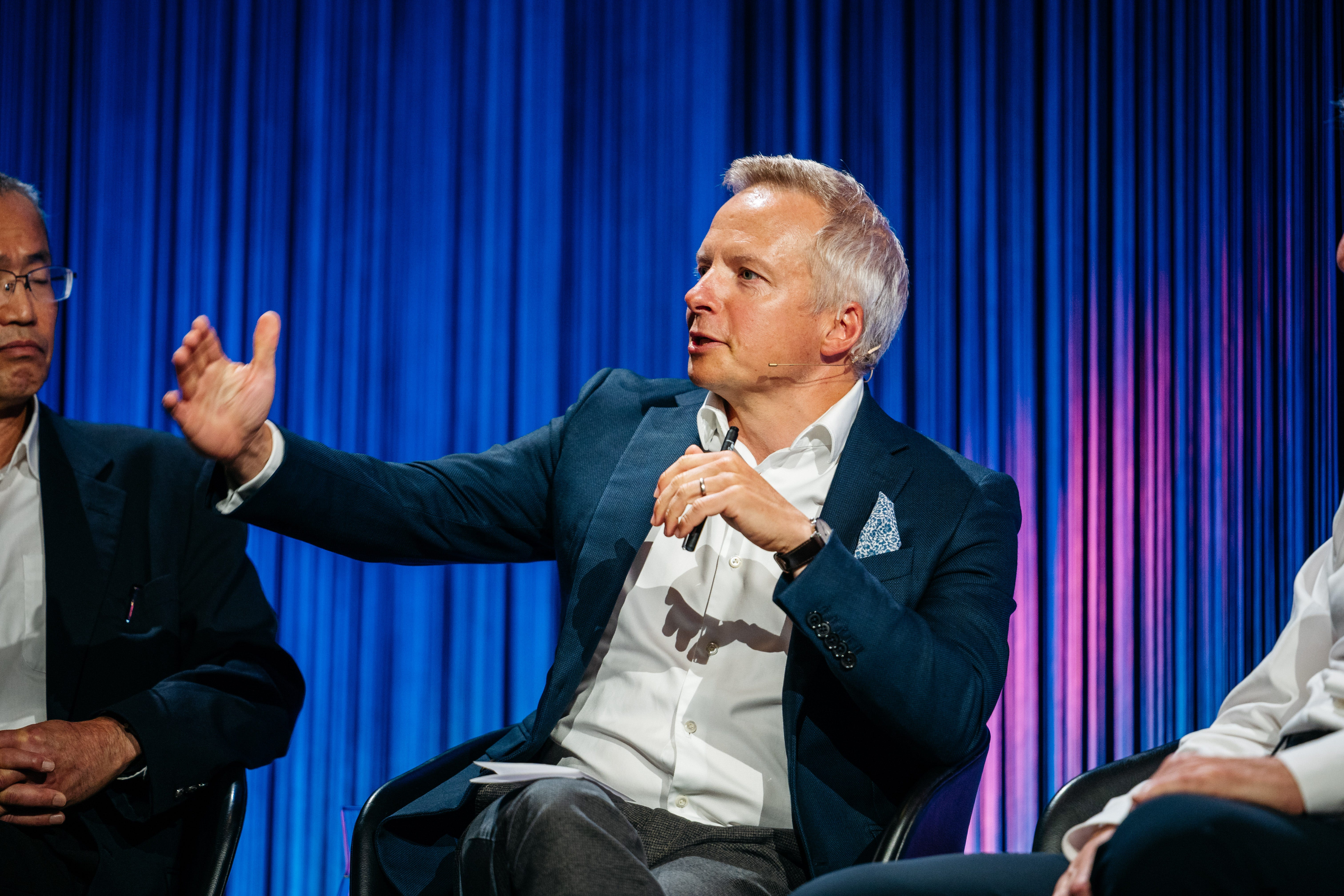
On the ONS 2026 panel on the technologies that could rewrite energy. Photo: Krafftwork.
Bold buyers create the market (The move)
Tipping points are not only observed. They are made. The market will appear when a few companies across the value chain team up to make a coordinated move that allows them to industrialise at scale. Industrialisation will then create the market.
Three groups can move now.
Electrolyser makers: standardise, build product lines, guarantee performance. Turn projects into products.
Hydrogen producers: build the second plant from the first one’s blueprint, close to the buyers, and get ready to scale up.
Customers in fertiliser, refining and aviation: sign long-term contracts, alone or in alliances, for a first slice of demand. These anchor customers are not only buying hydrogen. They are investing in a decreasing cost curve that will decarbonise their products to provide them with a competitive advantage.
The pessimism I met in Stavanger describes the current set of choices, not fate. The future of green hydrogen cannot be forecast along a straight line. It will be made, by those with the courage to move and trigger the cascading cost decrease that we sorely need.
Why this matters
The world will invest about $2.2 trillion in clean energy this year (IEA). To reach net zero by 2050, that needs to rise to about $4.5 trillion a year by the early 2030s (IEA). We are at less than half of what is needed.
This gap of more than $2 trillion a year is also an enormous business opportunity. Let us use it for economic growth that moves us back within planetary boundaries, seven of nine of which we have already crossed (Planetary Health Check 2025).
Europe is not too late to claim a share of the market for industrialised electrolysis. But China already holds nearly 60% of the world’s electrolyser manufacturing capacity (IEA) and accounted for nearly three-quarters of new installations in 2025 (IEA). The longer we wait, the more of the market and the value creation we leave to China.
Are you a maker, a producer or a buyer of hydrogen? Tell me what it would take for you to make the first move. Reply to this email or leave a comment below.
NEXT IN THE OFFSET · #2
Invented in Europe, industrialised elsewhere?
Will electrolysers be the next technology that Europe pioneers and others scale? In the next issue I look at which key technologies were invented, nurtured and industrialised in Europe, which were not, and what made the difference.
What I find especially useful here is the separation between technological feasibility, industrialization and market formation.
A technology can pass the first gate and still remain stuck if the surrounding market, infrastructure and contracts do not develop with it.
In that sense, the roadmap for hydrogen may need to map not only the technology trajectory, but also the sequence of buyers, enabling infrastructure and policy mechanisms needed to move each next actor.